
The Complete NEET Certificate Guide to Claim Your Dream MBBS Seat
OBC-NCL, EWS, SC/ST, PwBD, Gap — genuine claims still get rejected. Here's why, and how to fix it.
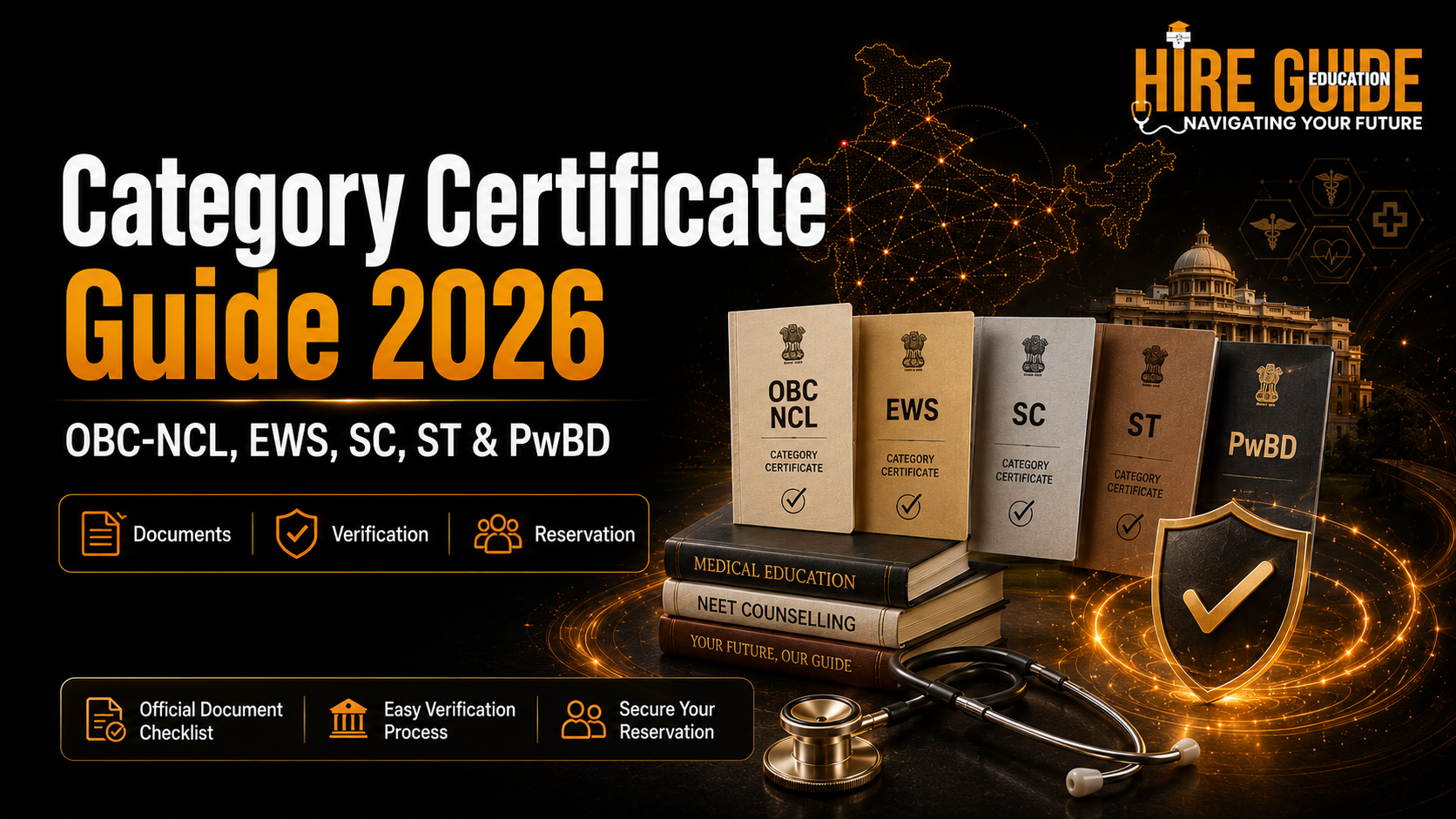
Quick summary
Plenty of students lose a reservation benefit — or a seat entirely — not because their claim was fake, but because a certificate was from the wrong list, the wrong authority, the wrong format, or simply missing. This is the guide meant to stop that from happening to you.
Main explanation
Introduction
Here's the uncomfortable truth about reservation certificates in NEET counselling: having a genuine claim isn't the same as having a certificate that counselling actually accepts. A student can belong to a real, recognised community, meet every income threshold, or carry a legitimate disability — and still watch that benefit disappear because the certificate came from the wrong list, the wrong authority, or an expired financial year. It's not fraud. It's paperwork mismatch. And it happens constantly.
This guide walks through exactly what's required for an obc certificate for NEET, EWS proof, SC/ST documentation, and PwBD reservation — the specific lists, formats, and validity conditions that decide whether your genuine claim actually survives verification.
Central and State Certificates for NEET Counselling Are Not the Same Document
This is the single most common mix-up in this entire process, so it's worth stating plainly before anything else: a certificate valid for a State reserved category doesn't automatically support the same claim at MCC or a central institution. Central OBC-NCL runs off the Central List, maintained under the national framework — and states routinely have different communities, different names for the same community, and different subcategories altogether. If you need both a central and a State claim, prepare separate documents for each. One certificate rarely covers both.
The same central-vs-state confusion extends beyond OBC — it's just as common with residency and citizenship proof, which is where a lot of students unknowingly disqualify themselves from seats they were otherwise eligible for.
Domicile Certificate for NEET
Domicile isn't about where you were born or where your school was — it's proof of current, established residency in a state, and it's what most State Quota seats and state counselling boards actually check before they'll consider you a "local" candidate. Confuse this with citizenship, and you can end up ineligible for the exact seats you were counting on, even with a perfectly valid NEET score.
What is a domicile certificate for NEET?
A domicile certificate is a state-issued document confirming you (or, in most states, your parent/guardian) have lived in that state for a minimum continuous period — usually somewhere between 5 to 15 years, depending on the state's own counselling rules. It's issued by the Revenue Department, Tehsildar, or SDM office, and every state counselling authority sets its own threshold and format, so a certificate that satisfies one state's rules won't automatically satisfy another's. This is the document that unlocks State Quota and management/NRI seats reserved for state residents — without it, you're generally pushed into All India Quota eligibility only, regardless of how long you've actually lived there.
Is a Domicile Certificate Required for NEET?
For State quota counselling, yes — a valid domicile certificate is typically required, since state quota seats are specifically reserved for candidates who meet that state's residency criteria. For All India Quota seats through MCC, domicile generally isn't the deciding eligibility factor in the same way, though some documentation may still be requested depending on the specific seat category.
The domicile certificate itself needs to come from the competent state authority, in the state's prescribed format, and needs to genuinely reflect your actual residency status as defined by that state's rules — which can vary meaningfully from one state to another in terms of how many years of residence, or which parent's residency, actually counts. If you're applying to more than one state's quota, don't assume a domicile certificate valid in one state automatically transfers to another; check each state's specific requirement separately.
How to get a domicile certificate for NEET?
The process runs through your state's revenue or e-district portal, and it typically looks like this:
Apply online via the state's e-district or Public Service Portal (most states have digitised this).
Upload proof of residence — ration card, voter ID, parent's long-term address history, or school leaving certificates showing continuous residence.
Submit to the local Tehsildar/SDM/Revenue Officer for verification.
Receive the certificate, usually within 15–30 days, though timelines vary sharply by state.
The one mistake to avoid: applying for this the week counselling opens. Verification backlogs are real, and a domicile certificate is one of the slower documents to process — start as soon as registration windows open, not after you've cleared choice filling.
What is a citizenship certificate for NEET & how is it different from a domicile certificate?
Where domicile proves which state you belong to, citizenship proves which country you belong to — and NEET requires Indian citizenship as a baseline eligibility condition for the vast majority of seats, independent of any state or reservation claim. For almost all applicants, this is satisfied automatically through a birth certificate, passport, or the citizenship declaration made at the time of NEET registration itself — most students never need a standalone citizenship certificate at all.
The confusion usually shows up with a specific group: candidates who've lived abroad for extended periods, hold dual documentation, or are applying under NRI quota. In these cases, a citizenship certificate (or equivalent proof, like a valid Indian passport) becomes a separate, non-negotiable requirement — and it does not substitute for domicile. You can be an Indian citizen with no domicile claim in a particular state, and you can, in rare edge cases, have domicile-adjacent ties to a state without the citizenship documentation being in order. Treat them as two independent boxes that both need checking, not one document that covers the other.
OBC Certificate for NEET: What Actually Qualifies
An OBC certificate for NEET only works for central purposes — meaning MCC counselling — if you belong to a community currently listed on the Central List, per the NEET UG 2026 bulletin. Being on your State's OBC list isn't the same thing, and it trips up more students than almost any other document issue on this list. A candidate can be genuinely, correctly OBC by their State's own recognition and still not qualify for central OBC-NCL reservation, simply because that community hasn't been notified centrally.
There's a second trap sitting inside this one: creamy-layer status. If a candidate falls into the creamy layer, they're treated as unreserved for the central OBC-NCL claim — the certificate might be current and correctly formatted, and it still won't help if the non-creamy-layer condition isn't met.
Is OBC Certificate Required for NEET, and What Should You Check?
Before you upload anything, check five things on the certificate itself: community spelling matches exactly, the community actually appears in the current Central List, the issuing authority is the correct competent one, non-creamy-layer status is explicitly stated, and the validity period matches what the current counselling cycle requires. A certificate that's factually true about your background but wrong on any one of these five points can still get rejected.
OBC-NCL Certificate vs. State OBC/SEBC Certificate
Think of these as two genuinely separate documents doing two separate jobs. OBC-NCL is specifically for central purposes and needs Central List eligibility. State OBC or SEBC certificates follow that state's own list and format, and work for that state's own quota seats. Using a State-format certificate where a central OBC-NCL certificate is required is exactly the kind of mistake that surfaces at document verification — usually at the worst possible moment, right when a seat is on the line.
EWS Certificate for NEET: More Than Just Income
A NEET EWS certificate needs to satisfy the prevailing income and asset rules together — not income alone. This distinction genuinely matters: an ordinary income certificate, the kind issued for a dozen other everyday purposes, is not automatically the same document as the Income and Asset Certificate that EWS reservation actually requires. The counselling authority can also specify a particular financial year or date condition that the certificate needs to satisfy, so a technically valid certificate issued for the wrong period can still fail.
If you're asking whether an income certificate required for NEET counselling is enough on its own — it generally isn't, for EWS specifically. Get the prescribed Income and Asset Certificate format from the current prospectus and compare it field by field before you rely on it.
SC and ST Certificates: Where Small Mismatches Cause Big Problems
SC and ST candidates need a valid certificate issued by the competent authority, and whether it works for State or central usage depends on the notified list and the candidate's state of origin. What actually causes rejections here is rarely the community claim itself — it's name mismatches, incorrect parents' details, a community spelling that doesn't exactly match the notified list, or a missing or unclear authority seal. An unclear or damaged scan is treated the same as a missing document, so don't submit anything you wouldn't be comfortable handing over as a physical original.
PwBD Reservation: UDID Is the Document That Matters
The 2026 bulletin is specific that PwBD admission candidates must follow NMC guidelines and submit the required disability documentation at counselling — and it points specifically to a valid UDID card plus the designated assessment process. Here's where families most often go wrong: a school medical certificate, or the accommodation certificate used during the exam itself for extra time, is not the same thing as the certificate needed for admission reservation. Those documents serve a completely different purpose and won't substitute for UDID-based verification.
Horizontal Reservation: An Extra Layer, Not a Separate Category
PwBD and certain State benefits can operate horizontally — meaning the benefit sits inside a vertical category like General, OBC, SC, or ST rather than existing as its own independent track. Practically, this can mean needing both the vertical-category document and the horizontal-reservation document together. Don't treat a horizontal benefit as something that stands alone without checking the current reservation matrix for exactly how it interacts with your primary category.
Gap Certificate for NEET
Reservation certificates aren't the only document that can quietly derail an otherwise strong application. If there's any break between your Class 12 completion and the year you're actually joining MBBS or BDS, expect the gap certificate question to come up — and it catches a surprising number of students off guard, including plenty who assumed a "genuine reason" was explanation enough on its own.
A gap certificate is a legal document, usually an affidavit, that explains why you took a break from education after Class 12 — whether that's a year spent purely on NEET preparation, a health issue, a family circumstance, or something else entirely. Counselling authorities want proof that the gap year wasn't spent enrolled in another course under a different identity, or otherwise doing something that would complicate your eligibility. Not every college or state asks for one. Plenty do, and if you're asked for it during document verification without having it ready, that's exactly the kind of delay that turns into a lost seat.
Gap Certificate for NEET Droppers
Here's something worth clearing up directly: there's no separate "dropper" or "repeater" version of this document. The format stays identical whether it's your first NEET attempt after a gap year or your third — the only thing that changes is how many years of gap you're accounting for and the reason given for each. If you took a drop year purely to reattempt NEET, that's a completely standard, well-understood reason authorities see constantly. What matters is that the affidavit states it clearly and consistently with your actual academic record.
One genuinely useful thing to know: if you joined any other course during your gap year — even briefly, even if you left it — that institution's own gap or transfer certificate may be required alongside your general gap affidavit. A gap spent purely on self-study or coaching, with no formal enrolment anywhere, is the simpler case to document.
What Is a Gap Certificate for NEET?
In plain terms, it's a notarised affidavit — not a school-issued document — confirming the number of years between your last qualifying exam (Class 12, typically) and your current NEET admission year, along with the reason for that gap. It exists to reassure the counselling authority that the gap was legitimate and that you weren't quietly pursuing another degree or engaged in something that would conflict with a fresh medical admission.
How to Get Gap Certificate for NEET?
The process itself is short, even though it involves a legal document. Gather your Class 10 and 12 certificates and identity proof first, since the affidavit needs to reference your academic timeline accurately. Draft the affidavit stating your name, the exact gap period, and the reason for it — most students draft this with a notary or advocate rather than freehand, since the wording and stamp-paper requirement matter. Get it notarised, either at a local notary's office or district court. Keep both the physical original and a clear scanned copy ready well before your counselling round opens, not after a college specifically asks for it.
Gap Certificate Format for NEET
There's no single, nationally standardised template — individual universities and state counselling authorities often specify their own preferred format, so the honest first step is always checking the current college's or state's prescribed format rather than assuming a generic template will pass. That said, most accepted formats share the same core elements: your full name and parents' names, your Class 12 board, roll number, and year of passing, the exact gap period being declared, the reason for the gap stated clearly, a declaration that you weren't enrolled in any other full-time course during that period (or details of the course if you were), and the notary's seal and signature on stamp paper. Match your draft against the specific college or authority's specimen before finalising it — a self-declaration without notarisation is generally not treated as equivalent to a proper affidavit for this purpose.
What Are the Other Documents Required for Medical College Admission
Beyond reservation certificates and the gap affidavit, a handful of other documents routinely show up on counselling and reporting checklists — and each one has its own specific gotcha worth knowing in advance.
Medical Fitness Certificate for NEET
A medical fitness certificate for NEET confirms you're medically fit to pursue a demanding, physically and mentally intensive medical education — this is a separate document from anything related to disability reservation, and the two shouldn't be confused. It's typically required at the reporting stage rather than during choice filling, issued by a registered medical practitioner or a specified government hospital, depending on what the individual college or state authority prescribes.
This is also where the semantic overlap with "medical certificate for NEET counselling" comes in — they're generally referring to the same underlying document, just phrased differently depending on where you encounter the requirement. Either way, don't assume a certificate issued for an unrelated purpose (a sports certificate, a general health check-up done months earlier) will substitute for what the college specifically asks for at reporting. Check the exact format and the list of authorised issuing practitioners in the current prospectus before you get one made.
Citizenship Certificate for NEET
For most Indian candidates, standard identity and academic documents already establish citizenship implicitly, so a separate citizenship certificate isn't routinely demanded. It tends to become relevant in specific situations — certain scholarship schemes, particular state quota categories, or cases where a candidate's documentation genuinely needs clarifying (a name or place-of-birth discrepancy, for instance). If a specific college or counselling authority does ask for one, it's usually satisfied through existing proof like a passport, birth certificate, or a domicile-linked document, rather than requiring an entirely separate certification process.
Validity, Date, and Format: The Part Nobody Reads Closely Enough
Authorities can prescribe a specific format, issuing date, or financial-year reference for any of these certificates — and a certificate can be entirely factually correct about your background while still being procedurally invalid for the current counselling cycle simply because it was issued outside the required window, or in the wrong template. Download the current specimen from this year's prospectus and compare every single field before uploading anything. This step takes fifteen minutes and prevents the kind of rejection that shows up with zero warning at verification.
Name and Data Consistency Across Every Document
Your name, your parents' names, category, and date of birth need to match across the NEET application, your academic records, and every certificate you submit. Where a genuine difference exists — a spelling variation, a legal name change — prepare the actual supporting legal document rather than hoping nobody notices. And this should go without saying, but: never digitally edit a scanned certificate to paper over a mismatch. That's not a document fix, it's a disqualifying problem waiting to be discovered.
Uploading and Reporting: Don't Let a Bad Scan Undo Good Paperwork
Scan the complete certificate clearly, including the back page and any annexures where they apply. Keep the file size within the portal's limit without compressing the text into illegibility — a technically-uploaded but unreadable scan can functionally count as no submission at all. Carry the physical original at reporting, along with photocopies. An online scan getting accepted during choice filling does not replace original document verification later.
Quick Reference: Claim, Verification, and Common Problem
Claim | Main Verification | Common Problem |
Central OBC-NCL | Community in Central List, valid NCL certificate | Only State OBC proof available |
State OBC/SEBC | State list and State format | Used for a central claim without eligibility |
GEN-EWS | Income and asset certificate in required period | Only an ordinary income certificate submitted |
SC/ST | Competent authority, notified community | Name or list mismatch |
PwBD | UDID or designated medical assessment | General medical certificate submitted instead |
Common Mistakes to Avoid
Using a State OBC certificate where central OBC-NCL is required
Submitting a plain income certificate instead of the EWS Income and Asset Certificate
Using an expired certificate, or one issued for the wrong financial year
Assuming any medical certificate automatically grants PwBD reservation
Uploading a cropped, blurry, or otherwise unreadable scan
Digitally editing a certificate to hide a name or data mismatch — don't do this, ever
Not Sure Which Certificate Applies to You?
A genuine reservation claim only holds up when the right document, from the right authority, in the right format, backs it up — and that's exactly the kind of detail worth a second pair of eyes before you're staring down a counselling deadline. Explore Counselling Plans for document-level support, or check the NEET Counselling Documents Guide for the complete document checklist beyond category certificates.
Related Reading:
Stay Connected:
WhatsApp Channel for counselling alerts and reminders
Instagram for short counselling explainers
YouTube for detailed guidance videos
Visit hireguideeducation.org for college data, cutoffs, counselling tools, and support.
Disclaimer: This article is for counselling awareness and planning. The latest official prospectus, seat matrix, fee order, bond rule, allotment result, and reporting instructions issued by the competent authority remain final.
FAQs
Can a State OBC certificate be used in MCC counselling?
Only if the candidate also independently satisfies the central OBC-NCL requirements — meaning the community must actually appear on the Central List, with the prescribed non-creamy-layer status.
Is a caste certificate the same as an OBC, SC, or ST certificate for NEET?
Not exactly — "caste certificate" is the general term people search for, but counselling authorities don't accept a generic one. What you actually need is category-specific: an OBC-NCL certificate if you're claiming OBC reservation (must show the "non-creamy layer" status and be from the Central List for MCC purposes), or an SC/ST certificate from a competent authority if you're claiming those categories.
Is EWS reservation based only on annual income?
No. Both the applicable income threshold and the asset criteria need to be satisfied together, through the specific Income and Asset Certificate format — not a general income certificate.
Is income certificate required for NEET counselling separate from the EWS certificate?
Yes, effectively — a general income certificate typically doesn't substitute for the prescribed Income and Asset Certificate that EWS reservation specifically requires.
Do PwBD candidates need a UDID card?
Yes. The 2026 bulletin points to a valid UDID card along with the prescribed admission assessment process — a school-issued or exam-time medical certificate isn't sufficient on its own.
Is there a rule around SC certificates in NEET counselling?
SC candidates need a valid certificate from the competent authority, matching name, parents' details, and the notified community exactly. Whether it works centrally or only at State level depends on the notified list tied to the candidate's state of origin.
Can I submit my category certificate for neet later, after choice filling?
Don't assume provisional acceptance. Follow the current registration and reporting requirement exactly as published — missing a document deadline can cost a claim even when the underlying eligibility was never in question.
What are the documents required for NEET registration 2026?
Registration itself asks for basic identity, educational, and photo/signature documents in the format NTA specifies for that year's bulletin. Reservation certificates, the gap certificate, and medical fitness proof are typically collected later, during counselling and document verification rather than at registration.
What is a NEET medical fitness certificate, and is it the same as a medical certificate for NEET?
Yes — these generally refer to the same document: proof from a registered medical practitioner confirming you're medically fit to pursue MBBS or BDS. It's collected at reporting, not at registration or exam stage, and it's unrelated to any PwBD disability documentation, which follows a separate UDID-based process.