
Beware of NEET Counselling Scams: Fake Seats, Agents, Websites & Payment Frauds
The pitch always sounds urgent. That urgency is the tell.
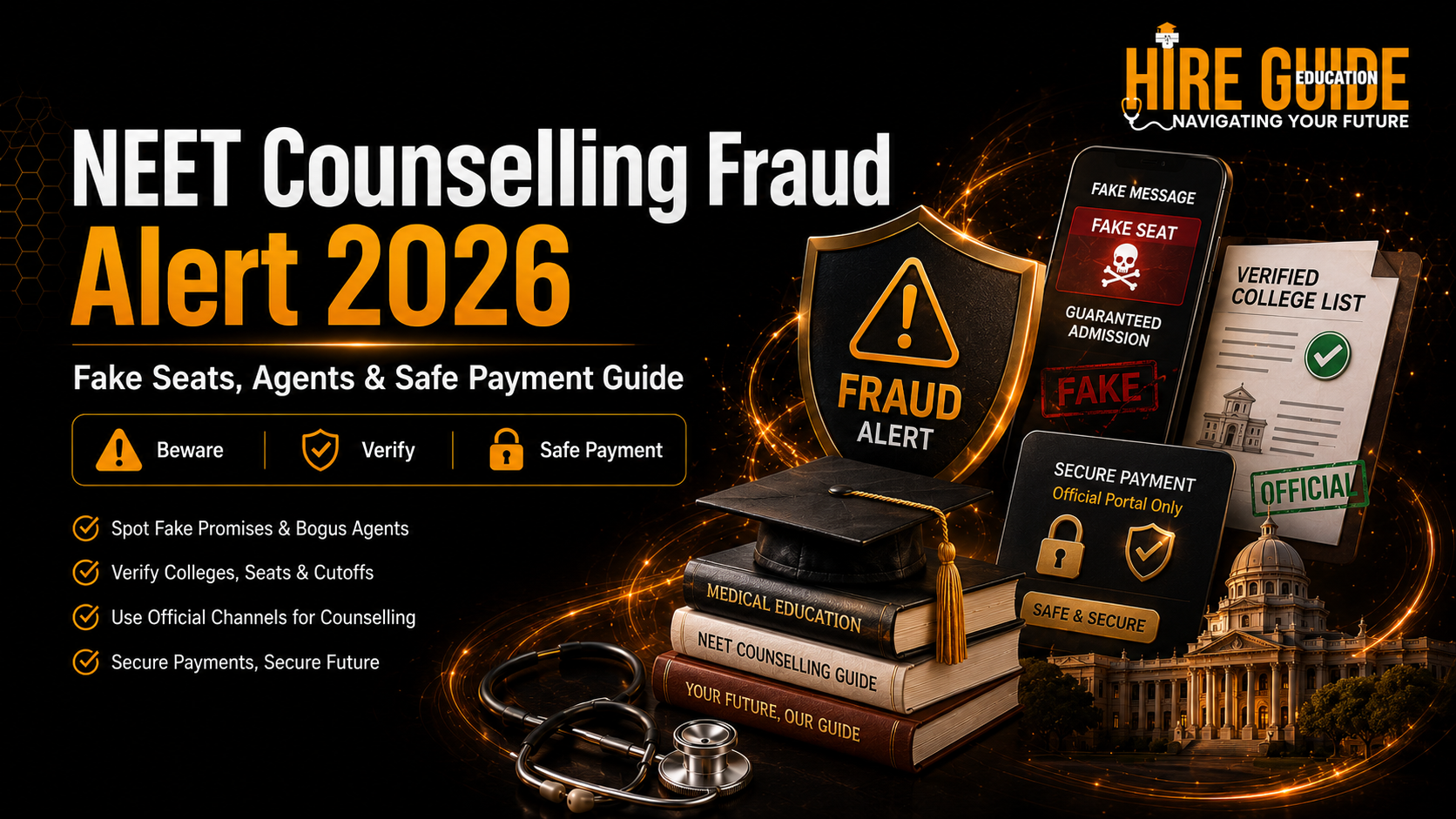
Quick summary
A "confirmed" seat, a director quota, a payment deadline in minutes — NEET scams follow the same script every season, and families still fall for it because panic doesn't leave room to check. Here's how to actually verify before you pay.
Main explanation
Introduction
Every counselling season produces the same headlines, just with different names attached. A jail superintendent in Unnao lost ₹23 lakh to a fake consultancy earlier this year. A seat-for-cash racket made news out of Lucknow. NTA issued a specific advisory in mid-July warning candidates about fake calls claiming a seat needs to be "blocked" immediately. NEET scams aren't a rare edge case — they're a predictable, recurring feature of every admission cycle, targeting exactly the families under the most pressure to say yes quickly.
This guide walks through how these scams actually operate — the fake seats, the fake consultants, the fake websites, the payment tricks — and exactly how to verify before you pay, not after.
What Is a NEET Scam?
A NEET scam is any scheme that promises admission, a confirmed seat, or a shortcut through the official counselling process in exchange for money or personal information — outside the legitimate NEET UG or NEET PG counselling system. This covers a wide range: MBBS admission fraud through fake "management quota" conversions, MBBS admission scam calls claiming a cancelled seat just opened up, fake websites mimicking official portals, and straightforward payment fraud dressed up as a processing fee or security deposit.
What ties all of these together is the same underlying fact: a genuine allotment only ever comes through the official counselling process and the candidate's own portal login. Anything that bypasses that — however convincing, however official-sounding — isn't a shortcut. It's the scam itself.
NEET Scam: UG and PG Both Get Targeted
NEET UG Scam Patterns
At the UG level, the most common pattern involves someone claiming access to a confirmed government seat, an "internal quota," a director quota, or a personal connection with the counselling authority. These calls almost always create urgency — payment needed within minutes, the "opportunity" closing today — because urgency is what stops a family from actually checking the claim before acting on it.
NEET PG Scam Patterns
NEET PG scams follow a similar script but often target candidates during later counselling rounds, when anxiety about ending up without a seat is highest. The same core rule applies regardless of level: PG seats, including management and deemed seats, are still allotted only through the competent authority's official process, with real eligibility checks attached.
NEET Fraud: How the Actual Schemes Work
Fake Consultants and Admission Agents
A NEET consultant offering genuine counselling analysis — cutoff trends, eligibility clarification, choice-filling strategy — is a legitimate professional service. What crosses the line is any NEET consultancy services provider or medical admission agent who claims they can secure, guarantee, or "arrange" a specific seat outside merit and official counselling. No NEET admission consultant, however senior-sounding or well-connected they claim to be, can create a legal seat that doesn't exist within the notified process — not for a government college, and not even for a high-fee management, deemed, or NRI seat, all of which still require official eligibility and allotment.
To verify a consultant before trusting them: check their actual business identity and office address, get a written service scope and an invoice, understand their refund policy, and ask where their cutoff data actually comes from. A legitimate consultant should never ask for the candidate's OTP, and should never request payment into an unfamiliar personal account. Counselling guidance is a professional service — it is not, and can never be, ownership of a seat.
Fake Admission Letters
Scammers can edit a PDF or fabricate a letter carrying a real college's logo, and a fake admission letter can look genuinely convincing at a glance — official-looking letterhead, plausible seat numbers, even a signature block. The only real verification is logging into the official candidate portal directly and checking the allotment result there, plus confirming through the institution's own official reporting system. A fake admission form sent over WhatsApp or email, however polished, should never be the basis for travel or payment — professional appearance is not proof of authenticity.
Fake Websites and the Importance of Checking the Real MCC Counselling Official Website
A fake website can copy an official authority's logo pixel-for-pixel and still ask you to enter a login, an OTP, or make a payment — none of which the real portal would request through a link sent in a message. Always reach the MCC counselling official website, or your state authority's portal, by typing the address directly or navigating from a source you already trust — never by clicking a link forwarded in a chat or SMS. A fake MCC website exists specifically to harvest credentials or payment details, and it can be difficult to distinguish from the real one without checking the domain carefully. Never install remote-access software or a browser extension recommended by someone you don't already know and trust.
Secure Payment: Where Fraud Actually Happens
Counselling fees and college payments should only ever go through the authorised portal or the exact institution account named in official documents. A personal account, a random QR code, or a request for cash collection is a serious warning sign regardless of how the request is framed. For genuine secure payment, verify the beneficiary name and account details against official documentation before transferring anything, and always get a proper receipt.
This applies just as much to secure online payment generally — a secure payment app protects you only if you're actually using it to pay a verified, official destination. Online payment security features on your end mean nothing if the account you're paying into was never legitimate in the first place. The technology isn't the vulnerability here; the unverified beneficiary is.
Guaranteed Rank or Cutoff Promises
A genuine counsellor can analyse historical cutoffs and help build a realistic strategy — what no counsellor can legitimately do is guarantee a specific closing rank or a confirmed allotment. Claims of "100% confirmed admission" or "secret cutoff manipulation" aren't insider access; they're the sales pitch. Ask any counsellor making strong claims to explain their actual data sources, your eligibility, and the real risk involved, in writing — a legitimate service will do this without hesitation.
Fake Refund and Bank Update Calls
A caller claiming to process a counselling refund may ask for your OTP, card PIN, screen-sharing access, or a small "verification payment" to release the funds. Official refund systems never require you to reveal banking secrets to receive money that's owed to you. If you get a call like this, use the finance contact and official notice published directly on the counselling authority's website — not the number the caller gives you.
Real NEET Fraud Cases Worth Knowing About
This isn't hypothetical risk. In 2026 alone, a jail superintendent in Unnao lost ₹23 lakh to a fraudulent consultancy promising a confirmed seat, and a separate seat-for-cash racket made news out of Lucknow. NTA itself issued a specific public advisory in mid-July warning candidates about calls demanding urgent payment to "block" a seat. These aren't edge cases from years ago — they're active, current patterns, which is exactly why verification habits matter more this season than a general sense of caution alone.
A Practical Example
A caller says a private MBBS seat has just become available and sends a college-branded letter to prove it. The family is asked to transfer a "booking amount" to a personal account before the opportunity closes. The correct response: stop, check the official state or MCC portal directly, and contact the institution only through its own official website — never through a number or link the caller provided.
Related Reading:
NEET Counselling Fees, Security Deposit and Refund: https://hireguideeducation.org/blog/neet-counselling-fees-security-deposit-refund-2026
Seat Allotment, Upgrade and Resignation: https://hireguideeducation.org/blog/neet-seat-allotment-reporting-upgrade-resignation-2026
How to Verify Any MBBS Admission Before You Pay Anything
Open counselling portals only from official government websites, typed directly rather than clicked from a message. Never share OTP, password, PIN, or screen access with anyone. Verify any allotment claim by logging into the candidate portal yourself. Pay only into the authorised portal or institution account named in official documents, and always check the beneficiary name and get a valid receipt. Reject any guaranteed-seat claim outright, no matter how it's framed. When checking whether an institution is legitimate, cross-reference nmc approved medical colleges data directly through NMC's official listing rather than trusting a college's own claim.
Family Payment Approval Rule
For every large payment, use two-person verification: one family member checks the official notice and the beneficiary details, another independently checks the amount and deadline before anything gets transferred. Write the purpose down in a shared family tracker. This small habit does more to prevent panic-driven mistakes than any single warning sign on its own — because scams work specifically by removing the time to check.
Quick Reference: Offer, Risk Level, Safe Response
Offer or Request | Risk Level | Safe Response |
Guaranteed government seat | Critical | Reject; use official counselling only |
Payment to personal UPI/account | Critical | Do not pay |
OTP/password request | Critical | Never share |
PDF allotment sent over chat | High | Verify directly in the candidate portal |
Refund call asking for PIN | Critical | End the call; check the official notice |
Counselling analysis with cited sources | Normal service | Review scope, invoice, and limitations |
Common Mistakes to Avoid
Trusting a copied logo or letterhead as proof of authenticity
Paying because an agent manufactured urgency
Sharing candidate login credentials with anyone, including a "helpful" consultant
Believing a high fee somehow makes direct admission legal
Using a personal account for any college tuition payment
Deleting fraud messages or payment evidence instead of preserving them
What to Do If You Suspect Fraud
Stop any further payment immediately. Preserve screenshots, call records, bank receipts, and account details rather than deleting them — they're evidence, not clutter. Contact your bank right away, report the transaction through the appropriate cybercrime channel, and inform the official counselling authority directly if their name was used without authorisation.
Official Sources
NEET UG 2026 Information Bulletin: https://cdnbbsr.s3waas.gov.in/s37bc1ec1d9c3426357e69acd5bf320061/uploads/2026/02/202602231394640855.pdf
MCC UG Medical Counselling: https://mcc.nic.in/ug-medical-counselling/
National Medical Commission: https://www.nmc.org.in/
NTA NEET UG Official Portal: https://neet.nta.nic.in/
Disclaimer: This article is for counselling awareness and planning. The latest official prospectus, seat matrix, fee order, bond rule, allotment result, and reporting instructions issued by the competent authority remain final.
Not Sure If Something You've Been Told Is Legitimate?
A genuine admission can always be verified on an official portal — protect the candidate's login, verify every beneficiary, and never pay for a promised seat outside real counselling. Check colleges directly through the Medical College Directory (https://hireguideeducation.org/colleges), run your rank through the NEET College Predictor (https://hireguideeducation.org/predictor) for a genuine, free shortlist, or get verified guidance through Counselling Plans (https://hireguideeducation.org/pricing) if you want a second opinion before trusting any offer.
Stay Connected:
WhatsApp Channel: https://whatsapp.com/channel/0029VbCkYqA1t90krIYMBV1A
Instagram: https://www.instagram.com/neetcounselling.hireguide/
Visit hireguideeducation.org (https://hireguideeducation.org/) for college data, cutoffs, counselling tools, and support.
FAQs
Can an agent guarantee an MBBS seat?
No. Allotment depends on merit, eligibility, the choices filled, actual seat availability, and the official counselling process — no individual can override that regardless of what they claim.
Is management quota direct admission legal without going through counselling?
No. Management and private seats still go through the competent authority's counselling and eligibility process — there's no legitimate "direct" route around it.
Can I share my OTP with my counsellor?
No. Only the candidate, or a trusted family member, should ever control login credentials and OTP — a legitimate counsellor never needs this to help you.
How do I verify an allotment letter is real?
Log in to the official candidate portal directly and check your allotment result there — never rely on a PDF or letter received through chat or email alone.
Where should NEET counselling fees actually be paid?
Only through the authorised portal or the specific institution account named in official instructions — never a personal account, QR code, or cash collection.
Is there a list of fake NEET consultancies in Delhi worth checking?
We're not going to publish a named list here, and it's worth explaining why: fraudulent operations shift names and locations constantly, a static list goes stale within a season, and naming specific businesses without a verified, ongoing legal process behind each claim carries real risk of getting it wrong. What actually protects you is the verification habit itself — checking business identity, office address, written scope, and refund policy for any consultant, in Delhi or anywhere else — rather than trusting a list to have caught every current scam operation.
How do I report NEET counselling fraud if it's already happened?
Contact your bank immediately to flag the transaction, file a report through the national cybercrime reporting channel, and inform the official counselling authority directly if their name or branding was misused in the scam.