
NEET Rank 2026: What Your AIR, State Rank & Category Rank Really Mean for Your MBBS Dream
One exam, three different numbers — and only one of them decides your MCC seat
Quick summary
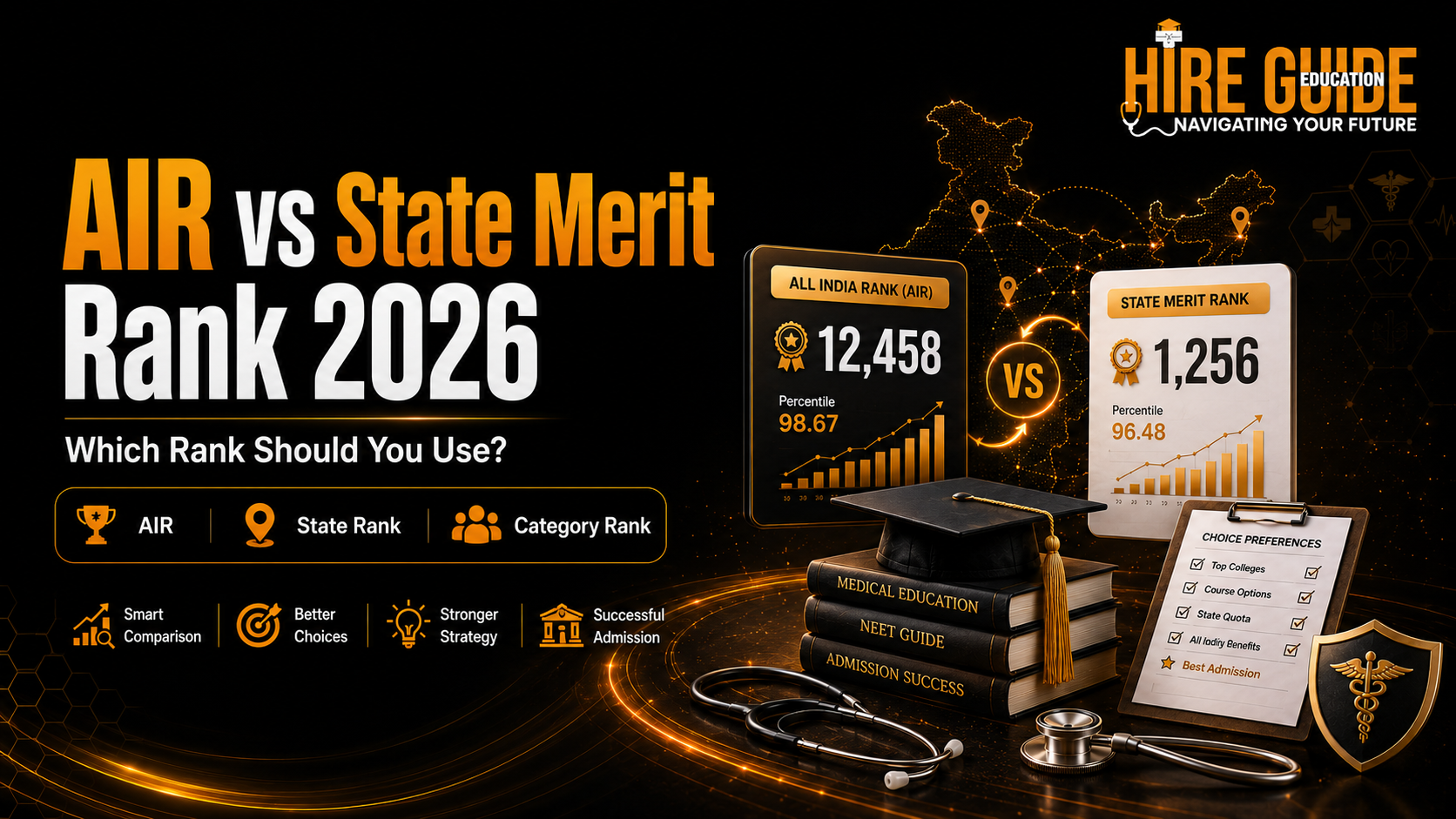
This blog explains the difference between NEET AIR, State merit rank, and Category rank, why the three numbers almost never match, and which one you should actually use for MCC counselling, state counselling, and cutoff comparison. It also covers NEET marks vs rank trends for 2026, minimum ranks typically needed for government MBBS seats.
Main explanation
Introduction
The result day is chaos. Your phone buzzes with your marks, your scorecard shows an All India Rank, your state portal later shows a completely different number, and your relatives are already asking "so which government college will you get?" This is the moment your NEET rank stops being a single statistic and starts being three overlapping stories — national, state, and category.
Most students don't lose seats because their rank was bad. They lose seats because they compare the wrong rank to the wrong cutoff. A category rank of 1,200 sounds thrilling until you realise it can't be placed next to a General AIR cutoff of 45,000. This blog exists to stop that confusion before choice-filling day, not after.
What Is NEET AIR (All India Rank)?
Your NEET All India Rank is the position NTA assigns you within the entire national pool of NEET UG candidates, based purely on your score in the exam. It is the one rank that every medical aspirant in the country shares the same yardstick for — a topper in Kerala and a topper in Punjab are both measured against the same national list.
AIR is the number you'll use for:
MCC's 15% All India Quota counselling
Central universities and deemed universities
Comparing your position against nationwide historical cutoffs
It's the closest thing NEET has to a universal currency. Everything else — state rank, category rank — is a local conversion of that same underlying score.
How NEET Aspirants Predict Ranks Based on Marks and Competition Level
Since AIR isn't announced the moment you finish the exam, most students spend the weeks before results trying to estimate it from their marks. This estimation depends on three moving parts:
Your raw score — obviously the biggest factor, but not the only one.
Paper difficulty that year — an "easy" paper pushes the same score to a lower rank because everyone scores higher.
Competition level — the number of test-takers and how the top few thousand scores are distributed.
This is exactly why two students with identical marks in different NEET years can land on very different ranks. A marks-based estimate is only ever a probability zone, not a guarantee — treat it as a starting point for planning, not the number you build your final college list around.
Start with These HireGuide Education Tools
Before you begin filling your choices, use these tools to research colleges and understand your admission possibilities.
Purpose | HireGuide Tool |
Research medical colleges | Medical College Directory – https://hireguideeducation.org/colleges |
Predict admission chances | NEET UG College Predictor – https://hireguideeducation.org/predictor |
Compare previous years' cutoffs | Cutoff Explorer – https://hireguideeducation.org/cutoff |
Understand counselling routes | State Quota vs All India Quota Guide – https://hireguideeducation.org/blog/state-quota-vs-all-india-quota-neet-ug-2026 |
Using these resources before counselling can help you create a balanced choice list based on your rank, category, budget, and admission goals.
NEET UG Rank List and State Rank Systems
Once NTA releases the NEET UG rank list, individual states pull from it to build their own eligible merit lists. This is where a second, separate rank enters your life.
State NEET Rank vs National AIR
A state rank is not simply "your AIR filtered to one state." State counselling authorities apply their own eligibility rules first — domicile proof, local registration, document verification — before generating merit. So a student who ranks poorly nationally might still get an excellent state rank, purely because the eligible pool for that state is far smaller than the national one.
This is why your state portal number and your NTA scorecard number will almost never be the same. Neither is "wrong" — they're answering two different questions.
A Quick Example: Karnataka NEET Ranking
Take Karnataka NEET ranking as a working example. Karnataka runs its own state counselling for a large share of MBBS/BDS seats under the state quota, and its merit list is prepared from candidates who registered specifically for Karnataka counselling and meet its domicile/eligibility conditions. A candidate with a moderate AIR nationally could still be well-placed within Karnataka's own merit list, simply because they're being measured against a state-specific candidate pool rather than the entire country.
The same pattern repeats across every state — Maharashtra, Tamil Nadu, Uttar Pradesh, Rajasthan — each with its own registration rules and its own version of the merit list. Always check the exact rank type your state authority publishes before comparing it to any cutoff table.
NEET Marks vs Rank 2026: What the Trend Usually Looks Like
One of the most searched questions every year is simply: NEET marks vs rank — what score puts you at what rank? While the exact numbers shift with every year's paper difficulty and the size of the candidate pool, a few patterns tend to hold:
Top ranks (AIR 1 territory) come from scores extremely close to the maximum, where even a handful of marks separate hundreds of candidates.
The middle of the distribution is the most crowded — small mark differences can shift your rank by several thousand positions.
Government MBBS seat competitiveness means even a strong score can land outside the safest zone if the year's competition was unusually high.
Because of this year-to-year variation, treat any marks-vs-rank chart — including your own past-year comparisons — as an estimate range, not an exact predictor. The safest approach is comparing your expected AIR against the last 2–3 years of actual closing ranks for your target colleges and quota, not just one year's data.
Category Rank in NEET: The Most Misunderstood Number
What Is Category Rank in NEET?
Category rank is your position among candidates within your specific reservation category — OBC, SC, ST, EWS, PwD — rather than among all candidates nationally or state-wide. Depending on the source, it might be calculated at the national level or within a specific state's eligible pool, so the exact meaning can shift from one merit list to another.
Does Category Rank Matter in NEET Counselling?
Yes — but only in the exact context it was designed for. Category rank absolutely matters when a counselling authority explicitly uses it to allot category-reserved seats. What it should never be used for is a casual comparison against a General-category AIR cutoff, because the two numbers are drawn from pools of very different sizes.
Is Category Rank Considered for NEET Counselling?
It is considered, but strictly within the reserved-seat allotment process defined by that specific authority — MCC, state board, or individual institution. Always check whether the cutoff table you're comparing against was built using category rank or AIR before drawing conclusions from it.
The golden rule: never place a category rank number next to a General AIR cutoff number. They are not the same currency, even when they look similar on paper.
Minimum Rank Required in NEET for MBBS in Government College
Every parent eventually asks this, and honestly, there's no single fixed answer — the minimum rank required in NEET for MBBS in a government college shifts every year based on total seats, category, state quota rules, and how competitive that year's exam was. Broadly, government MBBS seats (both AIQ and state quota) sit at the tighter end of the cutoff spectrum compared to private or deemed colleges, which is exactly why government-seat aspirants need the widest possible safety margin when comparing their rank to past closing ranks.
Rather than chasing a single "magic number," the more reliable approach is:
Comparing your rank against the last 2–3 years of round-wise closing ranks for your target colleges
Filtering by the exact same quota, category, and round type
Keeping extra cushion in your list if your state recently changed its merit format
NEET Courses List Rank Wise: Where Do You Actually Fit?
Once your rank is confirmed, the next natural question is which courses even open up at that range. A rough NEET courses list rank-wise looks like this (illustrative, not a guaranteed cutoff):
Top ranks: Government MBBS in the most sought-after institutes, AIIMS/JIPMER-pattern seats
Upper-middle ranks: Government MBBS in other state and central institutions, government BDS
Middle ranks: Private MBBS, deemed university MBBS, state quota BDS
Wider range: BAMS, BHMS, BUMS, BPT, BSc Nursing, and other allied and AYUSH courses
Course-wise cutoffs vary enormously by state, category, and quota, so treat this as a directional map, not a promise — your actual eligible course list should always come from matching your real rank against real, round-wise cutoff data.
A Quick Note on NEET PG Rank
While this blog mainly speaks to NEET UG aspirants, it's worth a short mention for postgraduate students too, since NEET PG rank works on a related but distinct system. NEET PG marks vs rank patterns, the PG rank card, and PG rank lists follow the same core logic as UG — a national rank, plus state/quota-specific merit lists — but the seat pool, specialty preferences, and counselling rounds are structured very differently from UG admissions. If you're a PG aspirant, treat UG cutoff data as directional only; always cross-check against PG-specific counselling sources.
Practical Example: Don't Make This Mistake
A student has an AIR of 48,000 and a state category merit rank of 1,200. An MCC college in their target list closed at AIR 45,000 last year. The only valid comparison here is 48,000 vs 45,000 — not 1,200 vs 45,000. Comparing the category rank against the AIR cutoff would make the seat look far more achievable than it realistically is.
Action Checklist Before Choice Filling
Download your official NTA scorecard and your state merit list separately.
Write the exact rank label (AIR / state rank / category rank) next to every number you note down.
Use AIR as your default for MCC/AIQ comparisons.
Use your state's own published rank type for state-level analysis — never substitute one for the other.
Match category, quota, and round exactly before comparing to any cutoff.
Ignore cutoff screenshots that don't label the rank type — they're incomplete data.
Keep a wider safety margin if your state changed its merit format recently.
Turn Your Rank Into a Real College List
Guessing your options from a rank number alone is how good seats get missed. Run your actual AIR, state rank, or category rank through the Hire Guide Education NEET College Predictor to see a realistic, data-backed shortlist of government, private, and deemed MBBS/BDS options — matched to your category, quota, and state.
Check your admission chances now — talk to a HireGuide Education counsellor on WhatsApp before you fill your choices.
Stay Connected with HireGuide Education
Need help throughout your counselling journey? HireGuide Education offers tools and resources to simplify every step of the admission process.
Medical College Directory
https://hireguideeducation.org/collegesNEET UG College Predictor
https://hireguideeducation.org/predictorCutoff Explorer
https://hireguideeducation.org/cutoffNEET UG Counselling Hub
https://hireguideeducation.org/counsellings/neet-ug
Stay updated through our official channels:
WhatsApp Channel:
https://whatsapp.com/channel/0029VbCkYqA1t90krIYMBV1AInstagram:
https://www.instagram.com/neetcounselling.hireguide/
Visit https://hireguideeducation.org/ for the latest counselling updates, medical college information, and admission guidance.
Disclaimer: This article is for counselling awareness and planning purposes only. Always verify the latest official prospectus, seat matrix, fee structure, bond conditions, allotment results, and reporting instructions from NTA, MCC, NMC, and your respective state counselling authority before final submission.
FAQs
What is a good NEET rank for a government MBBS seat?
There's no fixed universal number — it depends on category, quota, state, and that year's competition level. Compare your rank against the last few years of round-wise closing ranks for your specific target colleges instead of relying on a single benchmark.
What is NEET state rank, and how is it different from AIR?
State rank is the position assigned by a state counselling authority after applying its own eligibility and domicile rules, drawn from a smaller, state-specific candidate pool — unlike AIR, which reflects your position among all NEET candidates nationally.
Does category rank matter in NEET counselling?
Yes, but only where the counselling authority explicitly uses category rank for reserved-seat allotment. It should never be compared directly against a General-category AIR cutoff.
How can I check my NEET state rank list?
Your state's official counselling authority publishes the eligible merit list on its portal after registration and document verification — always refer to that official list rather than unofficial rank calculators.
Can NEET marks vs rank be predicted accurately before results?
Not precisely. Marks-to-rank estimates shift with paper difficulty and competition levels each year, so treat any prediction as a probability range rather than a fixed number.
Is NEET PG rank calculated the same way as NEET UG rank?
The underlying logic — a national rank plus state/quota-specific merit — is similar, but PG counselling structure, seat pools, and rounds differ significantly from UG, so UG cutoff data shouldn't be used to predict PG outcomes.